While of minor importance to most Turks in comparison to their national football team's efficient victory over a weak Bosnia-Herzegovina side and the team's resulting accession to the Euro 2008 tournament, this past week also featured the Turkish government culminating an impressive flurry of foreign affairs activity. Although the Turkish national team has little chance under its coach, Fatih Terim, whose arrogance shadows his remarkable flair for dramatic dress-shirt and jacket collars, the government's latest efforts will surely give Milli Takım fans something to talk about beyond their team's early exit from the European football championship tournament this summer.
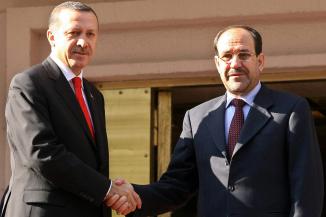
 Turkey's latest foreign affairs campaign began almost a month ago. Motivated by Turkey's highly theatrical bluff to invade northern Iraq, Ankara hosted a rather awkward summit with Iraq's Prime Minister Al Maliki. This visit was followed by King Abdullah of Saudi Arabia and his delegation of 11 planes. Erdoğan and Gül would then elegantly contrast the King's visit by hosting Israel's President Peres, in addition to Palestinian National Authority President Mahmoud Abbas. Other than the usual series of forced handshakes in front of photographers, Turkey announced that it would lead the development of the Erez Industrial Zone in order to promote foreign investment to a destitute region prone to terrorist activities.
The pace did not slow during this past week. Prime Minister Erdoğan inaugurated a gas pipeline between Turkey and Greece, a key component of the Nabucco pipeline project that transports Central Asian gas supplies to Central Europe. President Gül then participated in ground-breaking ceremonies for the new Baku-Tblisi-Kars railway, which has greater symbolic importance than practical potential due to the dilapidated nature the rail networks in all three countries. Turkey's efforts to pursue peace in Palestine were ultimately awarded with an invitation to the Annapolis Summit, which was a significant acknowledgment of Turkey's (otherwise weak) presence in Middle Eastern affairs.
In December, Turkish foreign minister Ali Babacan will visit Greece to strengthen ties and promote Turkey's candidacy for the EU.
The Turkish media has been bubbling with suggestions of Turkey's emergence as a regional hegemon. These sentiments are typified by an article by Fatih University academic, Gökhan Bacık:
Turkey seeks to take concrete actions in the Middle East to move regional politics from its current abstract content to a more practical and implemental level. This is also not surprising because Turkey has the ability and capacity to achieve this. The Erez Industrial Zone, which will be constructed under Turkey’s leadership in the West Bank, is exemplary...There is one simple fact behind Turkey’s ability to offer concrete options and opportunities: that Turkey is a historical actor that has many aspects in common with all the actors of the region. For this reason, its contribution to make the devised projects operational is vital. The operational opportunities of the other actors including the EU are limited.There is no doubt that Turkey should be commended for its recent surge in foreign affairs activity related to the Middle East. The country must do a better job of defining its modern identity in foreign affairs and this past month has been beneficial to that end.
However, this observer suspects that the ultimate success of Turkey's efforts will be tied to the true motivations for its involvement. If Turkey seeks engagement in a front-page issue like Palestine to self-promote its status as the EU's future bridge between Europe and the Middle East, it is doubtful that they will accomplish anything of note. However, if Turkey believes that it is in its own self-interest to develop such involvement in Middle Eastern affairs, with or without EU membership, then success will be much more likely. It is quite possible that Ankara is genuinely interested in forging stronger relations with Israel as a strategic advantage for the future.
 However, Turkey has been making a big push of late to secure public declarations of support for its EU candidacy from multiple EU members. It is consequently the opinion of this observer that Turkey's most recent efforts, and particularly those involving Palestine, are nothing more than an attempt to pursue newspaper headlines in order to influence the opinions of Brussels Eurocrats. Gül's plan to establish an economic zone in order to address the relationship between unemployment and terrorism seems particularly inane given Turkey's own domestic problems with terrorism. Perhaps Turkey would grab even more European headlines if it first solved the unemployment problem in its volatile southeastern region.